
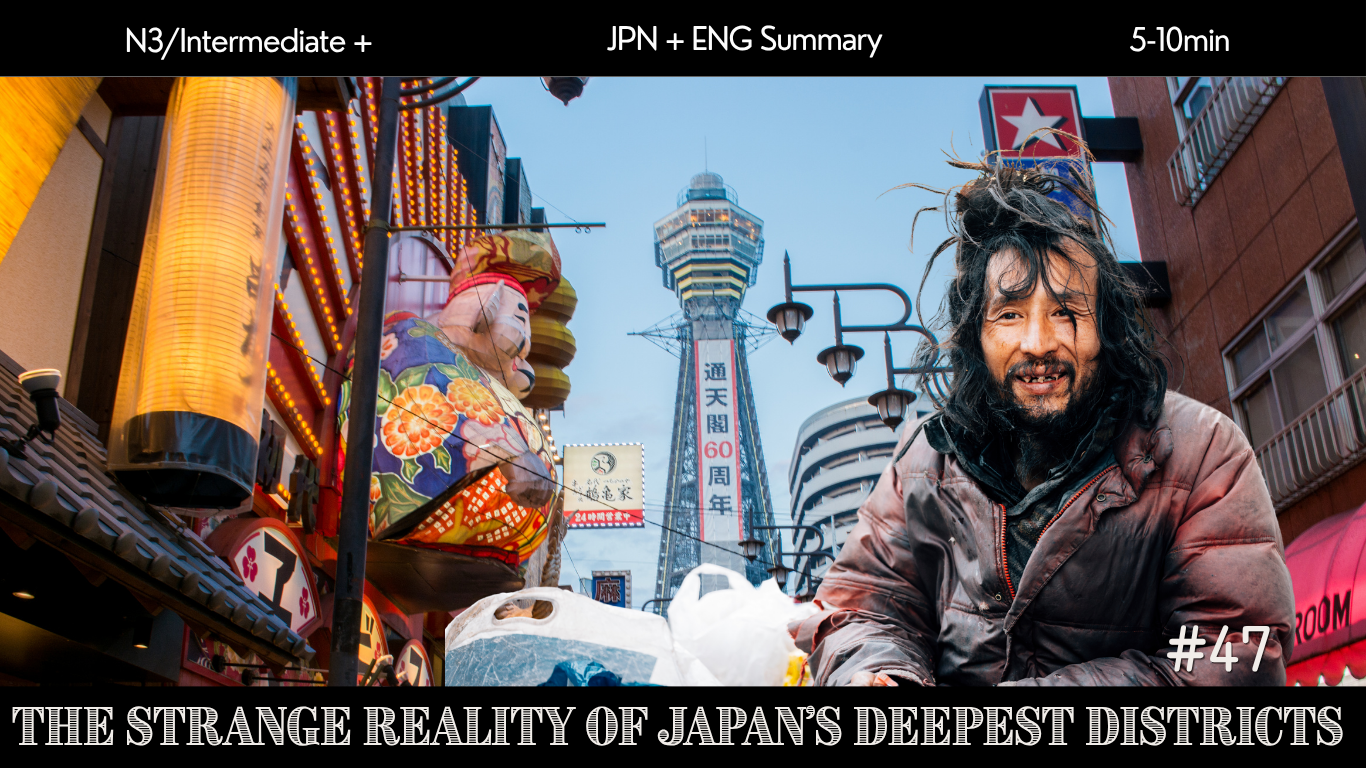

Every city has its bright spots and its dark corners, often referred to as slums.
Surprisingly, while Japan doesn’t have slums in the strictest sense, its equivalent areas have transformed in a very unexpected way.
日本に「スラム街(がい)」はない?
どんなものにも光(ひかり)と影(かげ)があります。きらびやかな繁華街(はんかがい)を都市の「A面」とするなら、スラム街は「B面」と言えるでしょう。
世界中に存在するスラム街ですが、実は「狭義(きょうぎ)の意味(=せまい意味)」では、日本にはスラム街はないとされています。これを聞くと、少し意外に思う人も多いのではないでしょうか。
日本の「ドヤ街」と大阪・西成(にしなり)
日本にはスラム街はありませんが、それに近い場所として「ドヤ街(がい)」と呼ばれる地域(ちいき)があります。その中でも特に有名なのが、大阪の西成です。
西成には、身分証(みぶんしょう)がなくてもできる仕事があると言われており、かつては犯罪者(はんざいしゃ)が身分を隠して逃亡(とうぼう)生活を送る場所というイメージもありました。そのため、詐欺(さぎ)や薬物(やくぶつ)といった、ありとあらゆる犯罪の温床(おんしょう)になっているのではないかと、怖い印象を持つ人が多かったのです。
危険(きけん)な場所から、外国人観光客のスポットへ
こう聞くと、西成はとても危険な場所に思えますが、現在の様子は全く違うと言います。最近ではバックパッカーや外国人観光客向けの宿泊所(しゅくはくじょ)として大人気(だいにんき)のエリアになっているそうです。
外国人がたくさん泊まりに来るということは、ある程度(ていど)は安全だということの証明でもあります。そこに泊まった人たちは、日本の最もディープな文化を体験していると言えるかもしれません。
みなさんの国にはスラム街がありますか?そこは地元の人なら安全に近づける場所ですか?それとも、絶対に近づいてはいけない危険な場所ですか?
Summary: The Safe Danger Zone
Strictly speaking, Japan does not have slums, but it does have “Doya-gai”—neighborhoods historically known for cheap day-laborer lodgings. The most famous example is Nishinari in Osaka, which once carried a dark reputation as a breeding ground for petty crime.
Today, however, this gritty district has reinvented itself into a popular destination for international budget travelers and backpackers. This unique transformation shows that even Japan’s most “dangerous” dark side maintains a level of public safety that surprises the world.
Vocab List
繁華街
・Noun
・はんかがい:Main street / Shopping and entertainment district
例 繁華街にはたくさんの人(ひと)が集(あつ)まってくる。
Many people gather in the bustling downtown area.
狭義
・Noun
・きょうぎ:Narrow sense / Strict sense
例 「健康(けんこう)」を狭義で定義(ていぎ)するのは意外(いがい)と難(むずか)しい。
Defining “health” in a narrow sense is surprisingly difficult.
ドヤ街
・Noun
・どやがい:Day-laborer district / Flophouse quarter
例 ドヤ街は日本版(にほんばん)スラム街(がい)と言(い)っていい。
You could call the “doya-gai” (flophouse district) the Japanese equivalent of a slum.
身分証
・Noun
・みぶんしょう:ID / Identification card
例 昔(むかし)は、日本(にほん)には身分証がなかったので、運転免許証(うんてんめんきょしょう)で身分(みぶん)を証明(しょうめい)していた。
In the past, Japan did not have a system of identification cards, so people used their driver’s licenses to prove their identity.
逃亡生活
・Noun
・とうぼうせいかつ:Life on the run / Fugitive life
例 ストーカーからの逃亡生活をもう7年(ななねん)も続(つづ)けている。
I’ve been on the run from a stalker for seven years now.
温床
・Noun
・おんしょう:Hotbed / Breeding ground (for crime, etc.)
例 SNS(えすえぬえす)は国際(こくさい)ロマンス詐欺(さぎ)の温床だと言(い)われている。
Social media is said to be a breeding ground for international romance scams.
バックパッカー
・Noun
・ばっくぱっかー:Backpacker
例 大学(だいがく)を卒業(そつぎょう)してからしばらくはバックパッカーとして世界中(せかいじゅう)を旅(たび)していた。
After graduating from university, I spent some time traveling the world as a backpacker.
宿泊所
・Noun
・しゅくはくじょ:Lodging house / Accommodation
例 この辺(あた)りは、簡易(かんい)宿泊所があって、多(おお)くの労働者(ろうどうしゃ)でにぎわっている。
This area has cheap lodging houses and is bustling with many laborers.
ディープな
・Na-adj
・でぃーぷな:Deep / Gritty and authentic (not superficial)
例 一口(ひとくち)に海外旅行(かいがいりょこう)といっても、表面的(ひょうめんてき)に楽(たの)しむ人(ひと)と、ディープなところまで行(い)っちゃう人(ひと)に分(わ)かれる。
When it comes to overseas travel, people can be divided into those who enjoy it superficially and those who delve deeper into the experience.






Comments